<?xml version="1.0" encoding="utf-8"?><feed xmlns="http://www.w3.org/2005/Atom" ><generator uri="https://jekyllrb.com/" version="3.10.0">Jekyll</generator><link href="https://imagexd.github.io/2018/2018/atom.xml" rel="self" type="application/atom+xml" /><link href="https://imagexd.github.io/2018/2018/" rel="alternate" type="text/html" /><updated>2026-11-18T01:03:32+00:00</updated><id>https://imagexd.github.io/2018/2018/atom.xml</id><title type="html">ImageXD</title><subtitle>This is an awesome site for Image Processing Across Domain.</subtitle><entry><title type="html">ImageXD Workshop 2017</title><link href="https://imagexd.github.io/2018/2018/workshops/workshop2017/" rel="alternate" type="text/html" title="ImageXD Workshop 2017" /><published>2017-03-29T00:00:00+00:00</published><updated>2017-03-29T00:00:00+00:00</updated><id>https://imagexd.github.io/2018/2018/workshops/workshop2017</id><content type="html" xml:base="https://imagexd.github.io/2018/2018/workshops/workshop2017/"><![CDATA[<nav class="toc">
<ul id="markdown-toc">
  <li><a href="#day-1-march-29th-learn" id="markdown-toc-day-1-march-29th-learn">Day 1, March 29th (Learn)</a></li>
  <li><a href="#day-2-march-30th-discuss" id="markdown-toc-day-2-march-30th-discuss">Day 2, March 30th (Discuss)</a></li>
  <li><a href="#day-3-march-31st-create" id="markdown-toc-day-3-march-31st-create">Day 3, March 31st (Create)</a></li>
</ul>

</nav>

<h2 id="day-1-march-29th-learn">Day 1, March 29th (Learn)</h2>

<h4 id="please-install-the-required-software-and-datasets-prior-to-the-tutorials"><strong>Please <a href="https://imagexd.github.io/2017/2017/03/20/tutorial-materials.html">install the required software and datasets</a> prior to the tutorials.</strong></h4>

<p>8:30 - 9:00 : Coffee</p>

<p>9:00–10:00 : <a href="http://scipy.org"><strong>NumPy, SciPy, and Matplotlib</strong></a>, an introduction
to numerical analysis with Python. This tutorial is aimed at those familiar with
Python, but who have not used NumPy, SciPy, and Matplotlib extensively before.</p>

<p>10:00–11:30 : <a href="http://scikit-image.org/"><strong>scikit-image</strong></a>, image processing in
Python. We introduce the scikit-image library, demonstrate its various
capabilities, and do several hands-on exercises to practice its use.</p>

<p>11:30–12:00 : <a href="http://dask.pydata.org/en/latest/"><strong>Dask</strong></a> for parallel
processing.</p>

<p>12:00–1:00 : Lunch (on your own)</p>

<p>1:00–2:30 : <a href="https://imagej.nih.gov/ij/"><strong>ImageJ</strong></a>, image processing in Java. We
will explore ImageJ and its SciJava interface with examples in Python and
Clojure.</p>

<p>2:30–4:00 : <a href="https://www.microsoft.com/en-us/research/people/vanim/">Vani Mandava</a>
from Microsoft Research will present image processing use-cases of the
<a href="https://azure.microsoft.com/"><strong>Azure</strong></a> cloud.</p>

<p>4:00–5:00 : <a href="https://www.tensorflow.org/">TensorFlow</a> and
<a href="https://keras.io/">Keras</a>. Deep neural networks in Python. In this tutorial we
learn how to train a neural network using the TensorFlow library, and how to
then apply it to scientific data.</p>

<h2 id="day-2-march-30th-discuss">Day 2, March 30th (Discuss)</h2>

<p><a href="https://docs.google.com/document/d/1KrPXkQN4_hWGzIFXvL6Bw3h0slc_jCF3FrfmDHwtNrk/edit?usp=sharing">Notes</a></p>

<h4 id="schedule">Schedule:</h4>

<p>8:30 - 9:00 : Coffee</p>

<p>9:00 : Welcome</p>

<p>9:15–9:45 : <a href="http://www1.icsi.berkeley.edu/~stellayu/">Stella Yu</a>, University of California, Berkeley: <strong>Learning to See the Image, Seeing to Learn the World</strong></p>

<p>9:45–10:15 : <a href="http://vis.lbl.gov/~tperciano">Talita Perciano</a>, Lawrence Berkeley National Lab.: <strong>Image Segmentation Across Domains using Parallel Markov Random Field Technique.</strong>  <a href="https://youtu.be/ou6vn5EiruM?list=PLA6PlfxWZPLQ097Q50htN-ndEZcHp9knc">Video</a>.</p>

<p>10:30–12:00 : Breakout sessions</p>

<p>12:00–1:00 : Lunch break</p>

<p>1:00–1:30 : <a href="http://research.majuric.org/public/">Mario Juric</a>, <strong>The University of Washington: Object Detection in Astronomy: Current Practice &amp; Challenges Going Forward</strong></p>

<p>1:30–2:00 : <a href="http://homes.cs.washington.edu/~kemelmi/">Ira Kemelmacher-Shlizerman</a>, The University of Washington: <strong>Modeling people from historical photos</strong>. <a href="https://youtu.be/DE3UH0g--zo?list=PLA6PlfxWZPLQ097Q50htN-ndEZcHp9knc">Video</a>.</p>

<p>2:00–2:30 : Claire McQuin, Broad Institute: <strong>Developing High Content Image Analysis Software for Biologists</strong>. <a href="https://youtu.be/6xJf1SBxvmU?list=PLA6PlfxWZPLQ097Q50htN-ndEZcHp9knc">Video</a>.</p>

<p>2:30–3:00 : <a href="https://www.alleninstitute.org/what-we-do/brain-science/about/team/staff-profiles/lydia-ng/">Lydia Ng</a>, Allen Institute for Brain Science: <strong>Delivering data, tools and knowledge on brain cell types, connections and activity</strong>. <a href="https://youtu.be/RpvNfcWi3Kc?list=PLA6PlfxWZPLQ097Q50htN-ndEZcHp9knc">Video</a>.</p>

<p>3:15–3:45 : <a href="http://kyleharrington.com/">Kyle Harrington</a>, University of Idaho: <strong>Biological Image Analysis using the ImageJ/Fiji Software Ecosystem</strong></p>

<p>4:00–4:45 : Breakout sessions</p>

<p>4:45 Wrap-up for the day</p>

<p>5:00 : Reception</p>

<h2 id="day-3-march-31st-create">Day 3, March 31st (Create)</h2>

<p>We will get together and work in teams to develop ideas around data,
software, algorithms, and learning. This open format will allow
participants to learn from each other, work together, and explore
concepts that cross domain boundaries.</p>

<p>8:30 - 9:00 : Coffee</p>

<p>9:00 - 10:00 : Project ideas discussion</p>

<p>10:00 - 12:00 : Group work</p>

<p>12:00 - 1:00 : Lunch (on your own)</p>

<p>1:00 - 1:30 : Updates</p>

<p>1:30 - 4:30 : Group work</p>

<p>4:30 - 5:00 : Final presentations</p>

<p><a href="https://imagexd.github.io/2017/" class="btn"> ImageXD 2017 Website </a></p>]]></content><author><name></name></author><category term="workshops" /><media:thumbnail xmlns:media="http://search.yahoo.com/mrss/" url="https://imagexd.github.io/2018/2018/%7B%22feature%22=%3E%22group-photo-2017.png%22,%20%22teaser%22=%3E%22logo_eScience_2.png%22%7D" /><media:content medium="image" url="https://imagexd.github.io/2018/2018/%7B%22feature%22=%3E%22group-photo-2017.png%22,%20%22teaser%22=%3E%22logo_eScience_2.png%22%7D" xmlns:media="http://search.yahoo.com/mrss/" /></entry><entry><title type="html">ImageXD Workshop 2016</title><link href="https://imagexd.github.io/2018/2018/workshops/workshop2016/" rel="alternate" type="text/html" title="ImageXD Workshop 2016" /><published>2016-06-07T00:00:00+00:00</published><updated>2016-06-07T00:00:00+00:00</updated><id>https://imagexd.github.io/2018/2018/workshops/workshop2016</id><content type="html" xml:base="https://imagexd.github.io/2018/2018/workshops/workshop2016/"><![CDATA[<p>At the inaugural ImageXD event, held at UC Berkeley’s Institute for Data Science (BIDS) on June 7-9, 2016, we gathered 50 researchers from 14 institutions representing expertise in computer vision, microscopy, materials imaging, photography, earth science, neuroscience, astronomy, software development, and more.</p>

<p>The common bond between all of these researchers coming from different domains is that they work with images as a primary source of data. Throughout the event, we learned from one another while strengthening ties across disciplinary boundaries and began the development of collaborations that we hope will have a lasting impact on the image processing community.</p>

<p>The ImageXD event included different emphases each day:</p>

<nav class="toc">
<ul id="markdown-toc">
  <li><a href="#learn" id="markdown-toc-learn">Learn</a></li>
  <li><a href="#discuss" id="markdown-toc-discuss">Discuss</a></li>
  <li><a href="#create" id="markdown-toc-create">Create</a></li>
</ul>

</nav>

<h2 id="learn">Learn</h2>

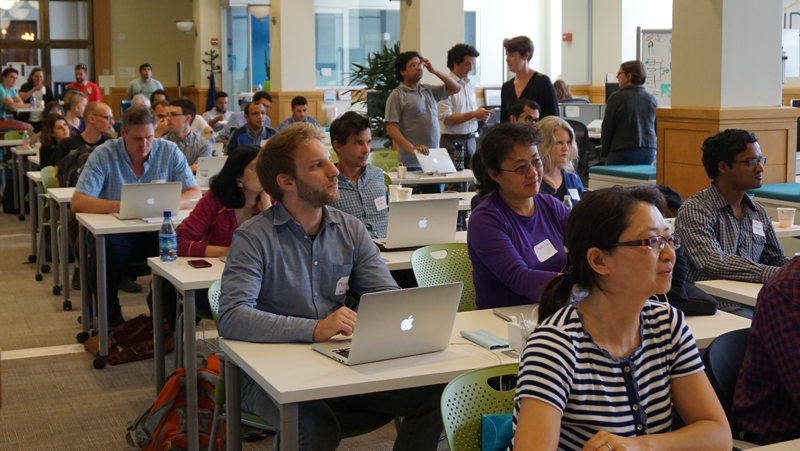
<p><img class="pull-right gap-left" src="/2018/images/group-photo-2016-learn.png" style="width: 250px;" /></p>

<p>On Day 1, the <a href="http://scikit-image.org/">scikit-image team</a> provided a technical workshop introducing methods in python to analyze image data. Their <a href="https://imagexd.github.io/tutorial/">training materials</a> are all openly available. Participants who were new to these approaches were also able to join a two-day <a href="http://software-carpentry.org/">Software Carpentry</a> workshop ahead of ImageXD to learn the basics.</p>

<h2 id="discuss">Discuss</h2>

<p>On Day 2, selected speakers shared their expertise before participants broke out into discussion groups.</p>

<p>The morning speakers addressed topics in computer vision, how we got here, and what to expect in the future:</p>

<ul>
  <li>
    <p>Daniela Ushizima (Lawrence Berkeley National Lab and BIDS):
  <a href="https://www.youtube.com/watch?v=tdg5JcFpALM">From Face Detection to the Faces of Scientific Images</a></p>
  </li>
  <li>
    <p>Jitendra Malik (UC Berkeley):
  <a href="https://www.youtube.com/watch?v=UKY4Y7sHg5g">Deep Visual Understanding from Deep Learning</a></p>
  </li>
  <li>
    <p>Susan Fong (Pixar):
  Image Processing at Scale (video not available)</p>
  </li>
</ul>

<p>The afternoon speakers shared their experience with image data and workflows at different scales:</p>

<ul>
  <li>
    <p>Ben Bowen (Lawrence Berkeley National Lab):
      <a href="https://www.youtube.com/watch?v=x0SSDNjQr0A">Web-Based Analysis of Mass Spectrometry Data</a></p>
  </li>
  <li>
    <p>Nouamane Laanait (Oak Ridge National Lab):
      Computer Vision Opportunities in Imaging of Materials (video not available)</p>
  </li>
  <li>
    <p>Ned Horning (American Museum of Natural History): <a href="https://www.youtube.com/watch?v=KZmwKbZa0ZI">Earth Science and Image Processing</a></p>
  </li>
  <li>
    <p>Matt Turk (University of Illinois):
  <a href="https://www.youtube.com/watch?v=K3b7-LUkE-o">Imaging and “Me”</a></p>
  </li>
</ul>

<p>Michael Beyeler, a Moore/Sloan Data Science and Washington Research Foundation Innovation in Data Science Postdoctoral fellows at UWdid an excellent job summarizing each of the above talks in his blog post, <a href="http://www.askaswiss.com/2016/06/imagexd-new-trends-image-processing-computer-vision.html">“ImageXD: New Trends in Image Processing and Computer Vision.”</a>.</p>

<h2 id="create">Create</h2>

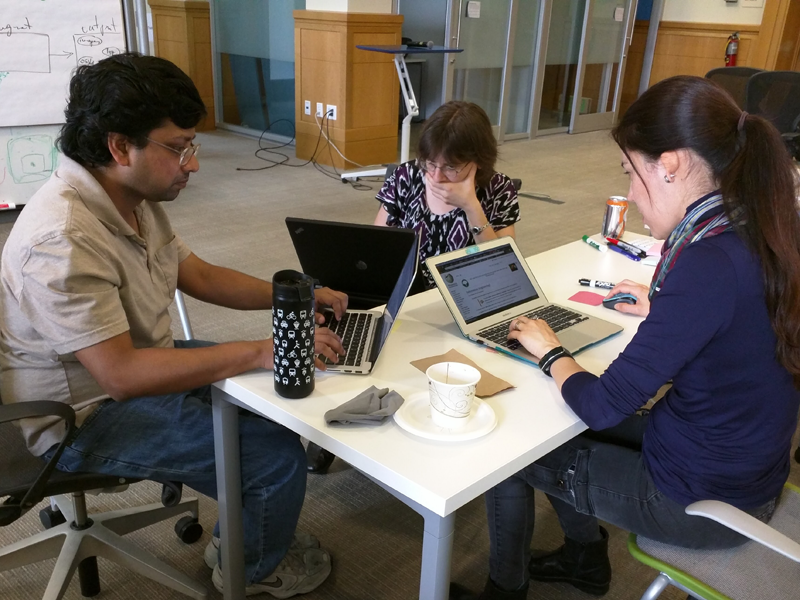
<p>On Day 3, several teams assembled to take on a variety of opportunities in data, software, algorithms, and learning. Some outputs	include the following:</p>

<p><img class="pull-right  gap-left" src="/2018/images/group-photo-2016-create.png" style="width: 250px;" /></p>

<ul>
  <li>
    <p>Training: The development of a blueprint that will be used to create a new Data Carpentry workshop meant to introduce researchers to modern practices in open source image processing. Borrowing from a number of great resources and adding a few more, this training will be openly accessible and used by Data Carpentry’s certified trainers around the world.</p>
  </li>
  <li>
    <p><a href="https://github.com/dani-lbnl/imageXDaugmentation">The Data Augmentation Toolbox</a>: A proof-of-concept for a toolbox that augments image data sets to create large and noisy training sets for machine learning applications.</p>
  </li>
  <li>
    <p>Experiments with novel combinations of different software platforms included an attempt to compile Halide-emitted source code with Cython (<a href="https://github.com/imagexd/skilide">https://github.com/imagexd/skilide</a>) and experiments in profiling scikit-image run with dask (<a href="https://github.com/michigraber/skidask">https://github.com/michigraber/skidask</a>).</p>
  </li>
  <li>
    <p>Data analysis projects included face detection implemented in scikit-image and detection of Aurora Borealis onset in video data.</p>
  </li>
</ul>

<p>At the conclusion of the event, it was apparent that we had hit a sweet spot in rallying an interdisciplinary group that still had a common bond. One participant described the ImageXD activities as transformative for their research, and the scikit-image team noted that they were grateful to have meaningful interactions with new and seasoned users that will help the community refine and further develop their application.</p>

<p>Moving forward, the ImageXD organizers, <a href="http://arokem.org">Ariel Rokem</a> (eScience), <a href="http://vis.lbl.gov/~daniela/">Dani Ushizima</a> (BIDS and LBNL), <a href="https://bids.berkeley.edu/people/st%C3%A9fan-van-der-walt">Stefan van der Walt</a> (BIDS), and <a href="https://bids.berkeley.edu/people/kevin-koy">Kevin Koy</a> (BIDS), are seeking feedback on the inaugural event, but we are also interested in hearing about things that this community could do in the future (e.g., the organization of a similar annual event). In the interim, we are working to establish an online community on <a href="https://imagexd.github.io/">imagexd.github.io</a> to facilitate discussions among image processing practitioners in different domains and different sectors, including academia, industry, non-profit, and government research labs. We hope that this combination of real-life and online forums for discussion will provide many people with a meeting place, a place to learn more from each and create new tools, ideas, and knowledge together.</p>

<p><a href="https://imagexd.github.io/2016/" class="btn"> ImageXD 2016 Website </a></p>]]></content><author><name></name></author><category term="workshops" /><media:thumbnail xmlns:media="http://search.yahoo.com/mrss/" url="https://imagexd.github.io/2018/2018/%7B%22feature%22=%3E%22group-photo-2016.png%22,%20%22teaser%22=%3E%22logo_BIDS_2.png%22%7D" /><media:content medium="image" url="https://imagexd.github.io/2018/2018/%7B%22feature%22=%3E%22group-photo-2016.png%22,%20%22teaser%22=%3E%22logo_BIDS_2.png%22%7D" xmlns:media="http://search.yahoo.com/mrss/" /></entry></feed>